Savannah Sprinkler Leak and Water-Waste Checklist
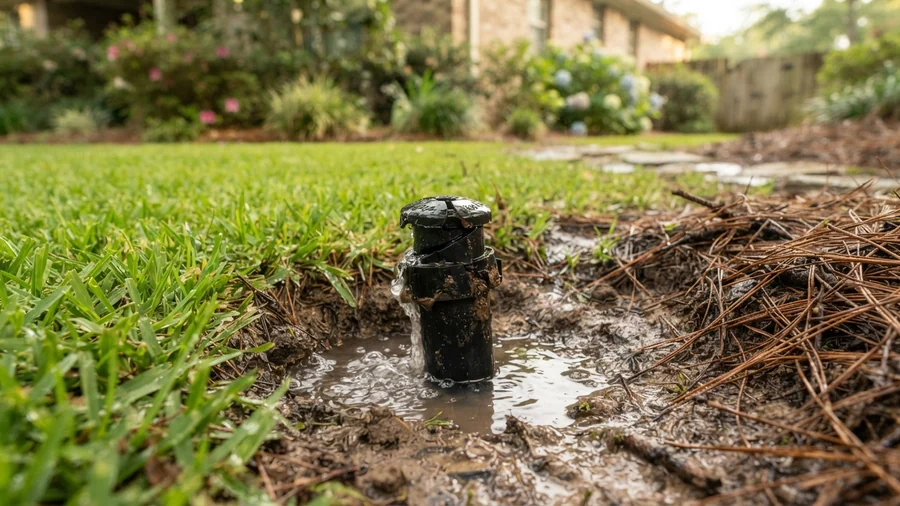
A Savannah sprinkler leak is not always a dramatic geyser. More often it starts as wet pine straw that never dries, a soft strip beside a walkway, runoff after one zone starts, or heads farther down the line that look weaker than normal.
This checklist is built for the moment before you call: separate schedule mistakes from actual water-waste clues, write down the affected zone, and connect the symptom to the likely repair path without guessing at the failed part.
Start with when the water appears
Timing is the fastest way to narrow a sprinkler leak. If the wet spot appears only while one station runs, the clue points toward that zone. If it stays wet long after the system is off, look for a valve, fitting, or low spot that may be holding water.
Savannah yards can make the timing harder to read because sandy soil drains quickly in some areas while pine straw and shade hold moisture in others. Check the same spot before the cycle, during the cycle, and after the zone shuts off.
- Wet pine straw or mulch after only one zone runs
- Water bubbling from the base of a head or riser
- Runoff toward a sidewalk, driveway, or low bed edge
- A valve box that refills during the irrigation cycle
- Weak pressure across several heads in the same station
- City of Savannah irrigation guidance — Official city background for reducing water waste and runoff.
- Water Connects Us All — Regional water-efficiency resource for leak awareness and outdoor water use.
Separate watering schedule issues from repair clues
A controller schedule can waste water when run times, start days, or seasonal settings do not match the yard. That is different from a leak. Schedule waste usually affects how long water runs; repair waste changes where water goes when the zone is on.
If every head sprays normally but the yard is being watered too often, start with the controller schedule and local irrigation guidance. If one head floods, one zone loses pressure, or water appears in a valve box, the system needs a repair-focused conversation.
- Savannah irrigation rules and controller schedule clues — Use this when the first question is whether the timer schedule is causing the issue.
- City of Savannah irrigation guidance — Official local context for irrigation timing and efficient watering.
Match the water-waste clue to the likely repair path
A broken head or cracked riser usually shows water around one sprinkler. A buried line leak often lowers pressure across the rest of the zone. A valve problem may keep water moving after the station should be off, or may leave the valve box wet during a cycle.
Do not dig before you know the pattern. Run zones one at a time only long enough to observe the symptom, then stop the affected station if water is actively wasting or washing soil away.
- Savannah irrigation leak repair — For buried-line, wet-soil, pressure-loss, and persistent leak symptoms.
- Savannah sprinkler head repair — For bubbling heads, cracked risers, clogged nozzles, and spray that misses the intended area.
- Why Savannah sprinkler valve boxes fill with water — Use this when the wet area is inside or near the valve box.
Use local water guidance as a reality check
Before assuming every wet area is a broken pipe, compare the symptom with the normal irrigation schedule and Savannah water-efficiency guidance. Official water-saving guidance is most useful for schedule, runoff, and overwatering questions; it does not replace field clues such as bubbling at one head, pressure loss across one station, or a valve box that refills during the cycle.
A practical caller note is simple: write down whether the water appears on an allowed watering day, whether it happens immediately after one station starts, and whether the same area gets wetter even when nearby heads look weak. That gives the repair conversation a clearer split between schedule waste, drainage, and a sprinkler part that needs diagnosis.
- Schedule clue: the whole yard runs too long or too often.
- Runoff clue: water leaves turf or bed areas before the cycle ends.
- Repair clue: one head bubbles, one zone loses pressure, or a valve box refills.
- Access clue: pine straw, roots, or sandy soil hide where the water first surfaces.
- City of Savannah irrigation guidance — Official city background for schedule waste, runoff, and practical conservation checks.
- City of Savannah irrigation guidance — Official local irrigation context to compare with timer and watering-day questions.
- Savannah watering rules and controller schedule guide — Use this when the main uncertainty is schedule behavior rather than a visible leak.
What to write down before calling
Good notes make the repair conversation faster. Write down the station number, where water appears, how long it takes to show up, whether pressure changes across the zone, and whether the controller stops the station normally.
Also mention recent storms, mowing, edging, digging, bed work, or roots near the wet spot. In Savannah, those local details often explain why a small leak appears first in pine straw, sandy soil, or a low valve-box area.
- Affected controller station or zone number
- Wet location: head, valve box, pine straw bed, turf, sidewalk edge, or driveway edge
- Whether water appears only during irrigation or stays after shutoff
- Whether other heads in the same zone look weak
- Recent storms, yard work, mowing, digging, or landscaping near the symptom
Questions to ask when you call
- Does this sound like a broken head, valve problem, or buried irrigation leak?
- Should I stop running the affected zone until it is checked?
- Is the water waste likely from the schedule or from a repair issue?
- What details should I mention about wet pine straw, runoff, or valve-box water?
- Could one leaking head make the rest of the zone look weak?
Related repair guides and manufacturer help
- Irrigation leak repair guide — Use this when water is surfacing, pressure is dropping, or a wet spot keeps returning.
- Wet pine straw leak guide — Helpful when the first visible clue is a wet bed edge or hidden head leak.
- Watering rules and controller schedule guide — Use this to separate schedule issues from field repair clues.
- Savannah sprinkler repair cost guide — Compare likely cost factors after identifying the symptom category.
- Water Connects Us All — Regional water-efficiency resource for leak awareness and outdoor water use.
Need help with sprinkler repair in Savannah?
Call 912-600-3745 and describe the symptom, where it appears, and what changed before it started.
Call 912-600-3745