Why a Savannah Sprinkler Leak Shows Up in a Pine Straw Bed
A wet pine straw bed after a sprinkler cycle is easy to blame on overspray. Sometimes that is all it is. In Savannah yards, though, pine straw can hide a small irrigation leak long enough for the nearby turf to dry out, the bed edge to stay soggy, or one head to start bubbling at the base.
The useful check is simple: look at when the water appears and what the rest of the zone does. If the bed is wet only while one station runs, or if heads farther down the same zone look weak, the problem may be a cracked riser, loose fitting, valve issue, root pressure, or buried lateral line rather than a spray-angle problem.
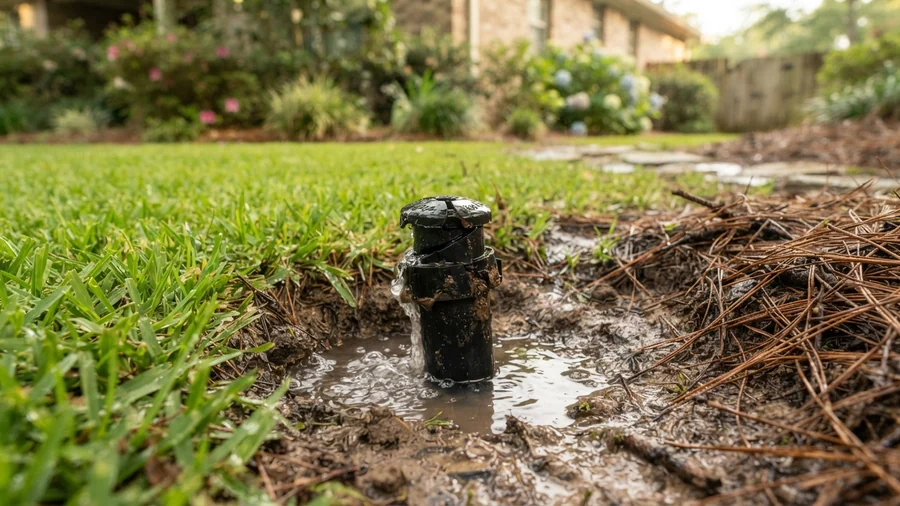
Why pine straw hides sprinkler leaks
Pine straw holds moisture on the surface and can cover low sprinkler heads, shallow risers, and small fittings near bed edges. A head that is tilted under straw may spray into the bed instead of turf. A cracked riser can bubble below the straw without making a clean puddle right away.
Savannah soil can make the clue harder to read. Sandy soil lets water move away from the broken part, while tree roots and bed edging can push shallow irrigation pieces out of alignment. The wettest patch may sit a few feet from the actual leak.
- Straw stays wet in one spot after a specific zone runs.
- A nearby head sits low, leans, or sprays under the bed edge.
- Water bubbles from sandy soil around one riser or fitting.
- Heads farther down the same zone look weaker than usual.
- Savannah irrigation leak repair — Use this when wet soil, bed-edge water, or pressure loss points below the surface.
- Savannah sprinkler head repair — Use this when one head is low, tilted, cracked, clogged, or bubbling at the base.
Separate overspray from an active leak
Overspray usually follows the spray pattern. The head pops up, water lands in the bed, and the rest of the zone still has normal pressure. A leak behaves differently. Water may rise from one spot, keep the straw wet after the cycle stops, or make nearby heads sputter because pressure is escaping before it reaches them.
Run the affected station briefly and watch the first minute. Do not dig through the bed blindly. Note whether water comes from the nozzle, the head base, the valve box, or the soil line along the bed.
- Overspray clue: water lands evenly where the nozzle points.
- Head clue: water bubbles around one pop-up body or riser.
- Line clue: wet straw appears between heads or along a bed edge.
- Valve clue: a valve box refills while the same station runs.
- Why a Savannah sprinkler head bubbles at the base — Useful when the wet pine straw sits beside one leaking pop-up head.
- Why Savannah sprinkler valve boxes fill with water — Useful when bed-edge water appears near the valve box too.
Local details that change the repair conversation
Mature roots, storm washout, mowing, edging, and fresh bed work all matter. If the leak sits near an oak root, a walkway, a driveway edge, or a bed that was recently refreshed, mention that before anyone starts guessing at parts.
Savannah homeowners should also note whether the area was already wet from rain. A valve box or pine straw bed can hold stormwater, but water that returns during an irrigation cycle points more strongly toward a system issue.
- City of Savannah irrigation guidance — Official local context for outdoor water use and runoff clues.
- UGA Extension Chatham County — Local extension reference for Chatham County lawn, soil, and landscape questions.
What to mention when you call
Say which zone was running, where the wet straw sits, whether one head bubbles or leans, and whether the rest of the zone lost pressure. Mention recent storms, mowing, edging, digging, root work, or new pine straw around the problem area.
If water is actively pooling, limit that station until the issue is checked. The goal is to start the call with the right repair path: head adjustment, cracked riser, valve issue, or hidden irrigation leak.
- Savannah sprinkler repair cost guide — Compare likely cost factors after you know whether the symptom is a head, valve, or leak issue.
- Savannah sprinkler troubleshooting checklist — Use this to organize zone, head, valve-box, timer, and leak clues.
Questions to ask when you call
- Does wet pine straw sound like overspray or a hidden irrigation leak?
- Could one leaking riser make the rest of the zone weak?
- Should I shut off the affected station until it is checked?
- What details help separate head repair from buried line tracing?
Related repair guides and manufacturer help
- Irrigation leak repair guide — For wet soil, pressure loss, hidden line breaks, and bed-edge leaks.
- Sprinkler head repair guide — For low heads, cracked risers, bubbling pop-ups, and spray adjustment.
- Bubbling sprinkler head guide — Useful when wet pine straw is tied to one leaking pop-up head.
- Savannah sprinkler repair cost guide — Compare cost factors for heads, valves, leaks, and diagnosis.
- City of Savannah irrigation guidance — Official local outdoor water-use context.
Need help with sprinkler repair in Savannah?
Call 912-600-3745 and describe the symptom, where it appears, and what changed before it started.
Call 912-600-3745