Savannah Sprinkler Troubleshooting Checklist Before You Call
A sprinkler problem is easier to explain when the symptoms are organized before the call. In Savannah, the same dry patch can come from a clogged head, a tilted riser, a valve that is not opening fully, sandy soil movement, or a small leak that only appears while the zone runs.
Use this checklist to gather the details that matter most: where the water appears, which station is affected, what the controller does, and whether storms, mowing, digging, or landscaping recently changed the yard.
Start with the affected zone
Run the problem zone long enough to watch the first minute. Heads that rise slowly, sputter, or never reach full height point to a different repair path than a head that pops up normally but sprays the wrong direction.
If only one head is weak, look at the nozzle, riser, and surrounding soil. If every head in the zone looks weak, the issue may involve pressure, a valve, wiring, or a leak before water reaches that section.
- Write down the controller station number.
- Mark whether one head, several heads, or the full zone is affected.
- Notice whether water bubbles from the base of a head.
- Check whether nearby zones run normally.
Check wet spots and valve boxes
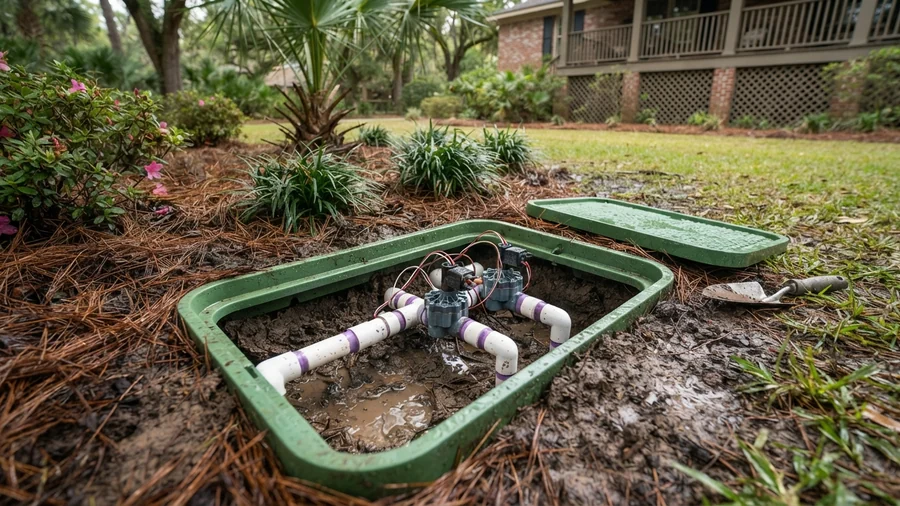
Savannah rain can leave a valve box damp, but water that returns during or after a sprinkler cycle deserves attention. A refilling box can point to a leaking valve, cracked fitting, or nearby line break.
Look for water in pine straw, along bed edges, beside sidewalks, or in low turf. The location helps separate drainage from an active irrigation leak.
- Does the water appear only when the sprinklers run?
- Does the valve box refill after you remove water?
- Is the wet area near roots, hardscape, or recent digging?
- Does pressure drop farther down the same zone?
- City of Savannah irrigation guidance — Official local context for irrigation timing, efficient watering, and outdoor-water symptoms.
- UGA Extension Chatham County — Local extension office reference for Chatham County lawn, soil, and landscape questions.
Use Savannah water clues as a reality check
Before assuming the controller or valve failed, compare the symptom with local watering guidance and recent weather. Overspray on pavement, runoff from a sloped bed, or a schedule that runs too long can waste water without proving that a buried line is broken.
Repair clues are stronger when the same spot gets wet only while one station runs, a valve box refills after water is removed, heads bubble at the base, or pressure drops across the zone. Those details help a phone call move past generic timer questions and toward the likely head, valve, wiring, pressure, or leak path.
- Note whether the wet area appears during a scheduled run, after rain, or while one station is manually active.
- Check whether water is reaching pavement, pine straw beds, low turf, or the valve box.
- Write down whether changing the schedule changes the symptom or the problem keeps returning.
- Use official city resources for watering context, then describe the field clue when you call.
- City of Savannah irrigation guidance — Official local context for irrigation timing, efficient watering, and outdoor-water symptoms.
- Water Connects Us All outdoor water guidance — Regional outdoor-water context that helps separate schedule waste from repair clues.
Separate adjustment clues from repair clues
Some sprinkler problems are coverage adjustments. A head may need cleaning, a new nozzle, or a spray-angle correction after soil settles or pine straw blocks the fan pattern.
Repair becomes more likely when there is bubbling water, a cracked body, a broken riser, a zone that will not start, or a zone that keeps running after the timer stops.
Details worth mentioning on the phone
A useful call starts with simple facts, not a diagnosis. Mention the zone number, where the wet or dry area sits, whether the timer behaves normally, and whether the issue started after storms, mowing, edging, digging, or yard work.
If you can safely turn off the affected zone or controller until the problem is checked, ask whether that makes sense for the symptom you are seeing.
Questions to ask when you call
- Does this sound like a head, valve, wiring, timer, or underground line issue?
- Should I turn off the affected zone until it can be checked?
- What details help narrow the diagnosis before a visit?
- Could recent storms, sandy soil movement, mowing, or digging be involved?
- What cost factors usually change this kind of sprinkler repair?
Need help with sprinkler repair in Savannah?
Call 912-600-3745 and describe the symptom, where it appears, and what changed before it started.
Call 912-600-3745