Why Sprinkler Zones Get Weak After Savannah Summer Storms
A Savannah sprinkler zone can look fine in spring and then turn uneven after a run of summer storms. One corner dries out, a head barely rises, pine straw shifts around a bed edge, or water bubbles near a valve box even though the controller still runs on schedule.
The tricky part is that heavy rain does not always mean the irrigation system is healthy. Storm runoff, sandy soil movement, roots, mowing, and saturated valve boxes can expose problems that were already developing. This guide explains what to look for before you call about a weak zone.
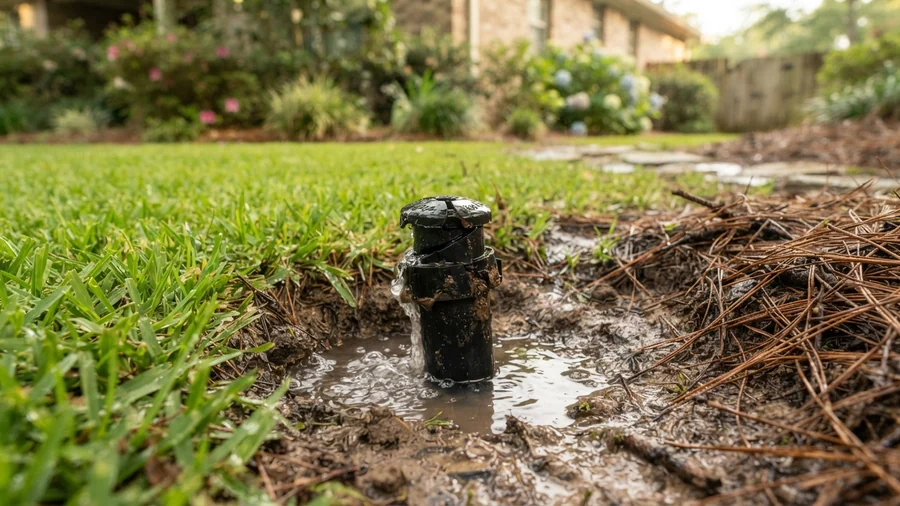
Why storms can change sprinkler coverage
Savannah yards often combine sandy soil, mature trees, pine straw beds, low spots, and humid summer weather. After repeated rain, soil can wash away from a riser, settle around a pop-up head, or move enough to tilt the spray pattern. A head that was aimed correctly last month may now spray mulch, sidewalk, or the side of a bed instead of turf.
Storms can also push grit into low heads and expose shallow PVC or fittings near bed edges. When one zone loses pressure after this kind of movement, the visible dry patch may be downstream from the actual leak.
- Sprinkler heads sitting lower than nearby grass after washout or settling
- Pine straw or mulch pushed over nozzles and blocking spray
- Water bubbling from the base of one head while farther heads look weak
- A valve box that stays wet after the rest of the yard dries
- City of Savannah irrigation guidance — Official city context for outdoor irrigation and efficient watering around Savannah.
- City of Savannah irrigation guidance — Useful background when runoff, overwatering, or storm-season adjustments may be part of the symptom.
How to separate a simple adjustment from a repair
A weak zone is sometimes a simple nozzle or arc adjustment, especially when the head pops up normally and the spray just misses the intended area. It is more likely to need repair when pressure drops across several heads, water appears from the ground, or the zone will not shut off cleanly.
Run only the affected zone long enough to observe it. Watch the first minute closely: heads that rise slowly, sputter, or never reach full height can point to pressure loss or clogging. If one head floods while the others stay weak, the issue may be at that head, riser, or nearby fitting.
- Adjustment clue: the head rises normally but sprays the wrong direction
- Clog clue: the head rises but has a broken or uneven fan pattern
- Leak clue: bubbling soil, standing water, or pressure loss across the zone
- Valve clue: the zone starts late, will not start, or keeps running after the timer stops
Savannah details to mention on the phone
The fastest sprinkler repair conversation starts with specifics. Instead of saying the system is not working, note which station is affected, whether the problem started after storms, and whether water is visible near turf, pine straw, a sidewalk, a driveway, or the valve box.
If the property has mature oaks, recent landscaping, fence work, bed expansion, or mower damage near the weak zone, mention that too. Those details help narrow whether the first check should focus on heads, risers, valves, wiring, controller settings, or a buried line.
- Which controller zone or station looks weak
- Whether the weak area is turf, a bed edge, a side yard, or a curb strip
- Whether water appears only while the zone runs or stays after it shuts off
- Recent storms, mowing, digging, edging, root work, or landscaping nearby
Repair-vs-replace decision support
Most post-storm sprinkler problems do not require replacing the whole irrigation system. A single tilted head, cracked riser, clogged nozzle, valve issue, or short section of damaged pipe can often be handled as a focused repair. Larger replacement conversations make more sense when several zones are aging, pressure is inconsistent across the whole property, or repeated repairs keep returning in different parts of the yard.
Before assuming the system needs major work, gather the visible symptoms and ask whether diagnosis can start with the affected zone. That keeps the conversation grounded in the actual problem instead of guessing from a dry patch alone.
Questions to ask when you call
- Does this sound like a sprinkler head, valve, wiring, or underground line issue?
- Should I turn the affected zone off until someone can look at it?
- What details help narrow the diagnosis before a visit?
- Could recent storms, soil movement, roots, or yard work explain the weak zone?
- What cost factors usually change the price for this kind of sprinkler repair?
Related repair guides and manufacturer help
- Why a Savannah sprinkler head bubbles at the base — Use this when a weak post-storm zone also has water escaping around one pop-up head.
- Savannah sprinkler rain sensor skips after storms — Use this when the controller looks normal but a recent storm or sensor setting may have skipped a watering cycle.
- Savannah sprinkler head repair — For tilted heads, cracked risers, clogged nozzles, and spray-pattern problems.
- Savannah sprinkler repair cost guide — Compare common cost factors for heads, valves, leaks, and diagnosis.
Need help with sprinkler repair in Savannah?
Call 912-600-3745 and describe the symptom, where it appears, and what changed before it started.
Call 912-600-3745