What Affects Sprinkler Repair Cost in Savannah, GA?
Sprinkler repair cost in Savannah usually depends less on the zip code and more on the kind of failure, where the part sits, and how easy the system is to diagnose. A visible broken head in open turf is a very different job from a leak buried near a bed edge, a valve box full of water, or a zone that only fails after heavy rain.
If you are trying to understand whether the problem looks small, moderate, or more involved, the easiest way to start is to sort the symptom first. That gives you a better read on likely cost before anyone starts digging or replacing parts.
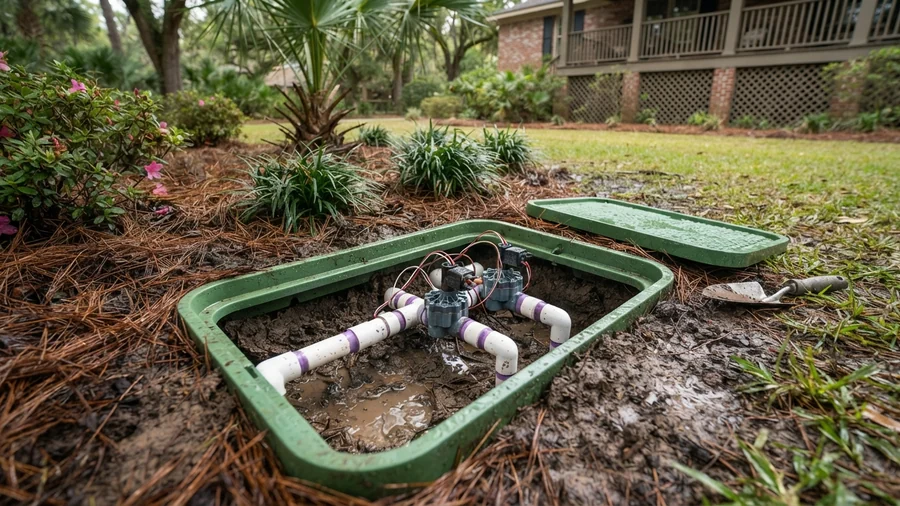
The parts that usually change the price
Most sprinkler repair quotes in Savannah come down to the same handful of parts: heads, risers, valves, wiring, controller settings, and buried lines. A single head replacement is usually simpler than a valve rebuild, and both are usually easier than tracing a leak under wet pine straw or around a crowded valve box.
The more the technician has to diagnose before the repair can begin, the more the job tends to move toward the higher end of the range. That is why two homes with similar-looking dry spots can still end up with very different repair bills.
- One exposed head in open grass is usually simpler than buried pipe or valve work.
- A wet valve box adds diagnosis time because water, sand, and wiring may all be involved.
- Leak tracing takes longer when the wet area is not sitting directly over the break.
- Multiple weak zones can point to a larger system issue instead of a single part.
Why Savannah yards can be easier or harder to repair
Savannah yards often mix sandy soil, pine straw, mature trees, and storm runoff. Those conditions can make a small issue appear bigger, or hide the real problem under a layer of mulch, damp soil, or settled bed material. A head that sits low after washout may only need adjustment, while a head that keeps flooding may be cracked below the turf line.
Weather also matters. After storms, a zone can look weak because the soil moved around the head, because water collected in the valve box, or because a small leak became easier to see once the yard soaked in. The repair cost is affected by whether the issue is still a simple adjustment or whether the zone is actually losing water.
- Storm runoff can expose shallow pipe or shift head height.
- Pine straw and mulch can hide a low or tilted sprinkler head.
- Roots and edging work can damage shallow lines near beds and curb strips.
- Wet soil around a valve box can point to a different repair path than a dry turf strip.
- City of Savannah irrigation guidance — Official local background for outdoor water use, runoff clues, and efficient irrigation habits.
- UGA Extension Chatham County — Local extension reference for Chatham County lawn, soil, and landscape questions.
When a simple adjustment is enough
Not every weak zone needs replacement parts. If the head pops up normally and the spray pattern simply misses the target area, the first fix may be an adjustment to the nozzle, arc, or height. The same is true for timer issues, a station that was programmed wrong, or a controller setting that was changed by accident.
That is why the first step is to describe what the zone is doing, not just that it is not working. A clear symptom can separate a small correction from a repair that needs parts and labor.
- Adjustment clue: water reaches the wrong place but pressure is still normal.
- Clog clue: the head rises but the spray is weak or uneven.
- Repair clue: bubbling soil, standing water, or a zone that loses pressure as it runs.
- Controller clue: the schedule is off, but the hardware may still be fine.
What to mention before scheduling
A useful phone call gives a quick picture of the system. Note which zone is affected, whether water is pooling or just missing coverage, whether the problem started after storms or yard work, and whether the valve box looks wet. Those details help narrow whether the likely work is a head replacement, valve service, leak tracing, or a controller check.
If you want a better cost estimate, mention the access too. A head in open turf is different from a line under gravel, a buried fitting near a hardscape edge, or a valve box packed with mud and roots.
Questions to ask when you call
- Does this look like a head issue, valve issue, leak, or controller problem?
- Is this likely a simple adjustment or something that needs replacement parts?
- What details would help estimate the cost before a visit?
- Should I turn the affected zone off until it is checked?
- Could the recent storms or yard work have caused this problem?
Need help with sprinkler repair in Savannah?
Call 912-600-3745 and describe the symptom, where it appears, and what changed before it started.
Call 912-600-3745